
Feature · Jira, Zapier, API & MCP Integrations
A resource platform is only as good as what it connects to
Your people, projects, and numbers already live across a handful of systems — the tool where work gets done, the one where hours get logged, the place where finance keeps score. Planning falls apart when those worlds don't talk to each other. So we're building Alloxy to connect. Not with a closed list of integrations we picked for you, but with four open paths to bring your stack together: connectors to the systems you rely on, low-code automation for the long tail, an API for the systems only you have, and MCP for the AI agents you're starting to build. Some of this is here first; most of it is on the way. This page is the direction we're travelling — and an open invitation to help us steer.
Connectors to the systems you already run
The first connector is Jira.
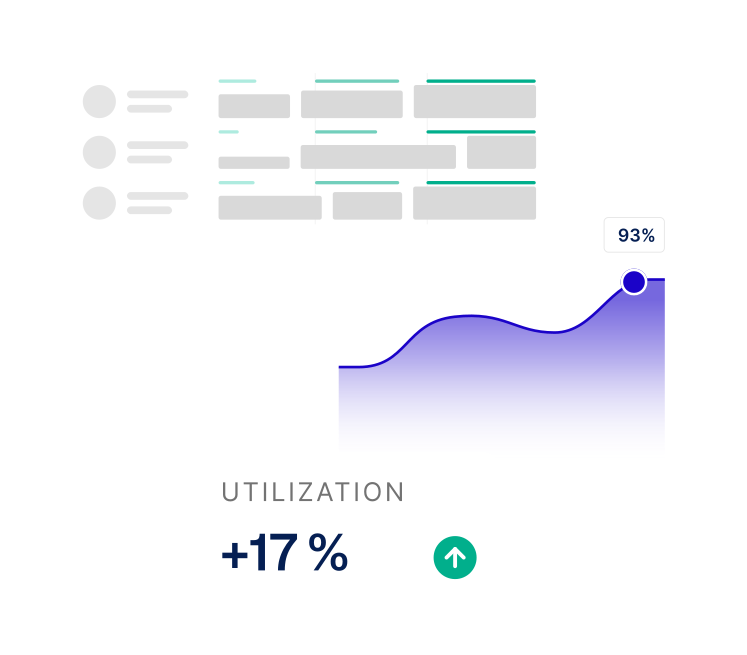
Log your time in Jira, where your delivery teams already work, and see it flow straight into Alloxy. No parallel timesheet, no double entry, no chasing people to record the same hours twice. Once actuals land next to your plan, the numbers you've been missing come into view: actual versus scheduled, real utilisation instead of a guess, and true cost against what you budgeted. That's the pattern every connector will follow — bring real data in from where work happens, so planning and reality finally sit side by side. Jira is where we start because it's where so many of our customers live. Where we go next is up to you.
Jira, Zapier, API & MCP Integrations
We build connectors on a need basis. If a system you depend on isn't connected yet, tell us. We'll evaluate it, and if other customers need the same thing, we'll build it. That's the deal — you get integrations that matter to your work, not a museum of connectors nobody uses.
Low-code, no-code automation
Not every system needs a hand-built connector. For the long tail of tools your business runs on, Alloxy will be available on Zapier — the automation platform that links 1,000+ applications with little or no code. That opens up a lot: push new allocations into your calendar, sync projects from your CRM, log deals as demand the moment they close, notify a channel when someone tips into overbooking, or keep a finance sheet updated without touching it. Typical candidates our customers reach for include accounting and finance tools like Xero and QuickBooks, CRMs like HubSpot, Salesforce, and Pipedrive, project and task tools like Asana, monday.com, and ClickUp, HR systems like BambooHR and Personio, and the everyday glue of Slack, Microsoft Teams, Google Sheets, and Outlook. If you can describe the workflow, you can usually build it yourself — no developer required.
An open API
Some systems are yours alone — a legacy platform, a tailor-made internal tool, something no connector will ever cover. For those, Alloxy will offer an open API, so you can read and write the data you need and wire Alloxy into your own systems on your own terms. And if you don't have the capacity to build that connection in-house, you don't have to. We offer integration services to do the work with you, so a missing API skill never stands between you and a connected stack.
MCP for your own agents and AI
The way teams work with software is changing. More of our customers are building their own AI agents and assistants — and those agents need a way to reach the tools they act on. Alloxy will be accessible through MCP (the Model Context Protocol), the emerging standard for connecting AI agents and LLMs to real systems. That means your own agents can query Alloxy in plain language — who's free next month, which projects are slipping on margin, where's our capacity risk — and, where you allow it, act on the answer. Build a staffing assistant, wire Alloxy into an internal copilot, or let your LLM of choice reason over live capacity and cost. Your agents, your rules, your data.
Help us build the right connections
We'd rather build the integrations you actually need than guess. So tell us what's in your stack, what you're tired of copying by hand, and where the gaps hurt most. If a connector matters to you and to others like you, it moves up the list — and gets built.
More features